There was a stage in school when I genuinely felt bored by mathematics and physics.
Not because the subjects were unimportant, but because I could not yet see what they were for.
A page filled with angles, trigonometric identities, derivatives, vector operators, and field equations can feel exhausting when all you see is symbolic pressure and no living context. At that age, it is easy to ask:
Why am I spending so much time on this?
Where does this appear in practical life?
At the time, those questions felt reasonable to me. I could solve exercises, but I could not yet see a convincing bridge between formal mathematics and the real world.
What changed later was not the symbols. What changed was my perspective.
Once I moved into scientific computing, image analysis, quantitative modelling, and machine learning, I started to recognise that many of those old formulas were not isolated school tasks at all. They were compact descriptions of mechanisms:
That is the broader idea behind this post.
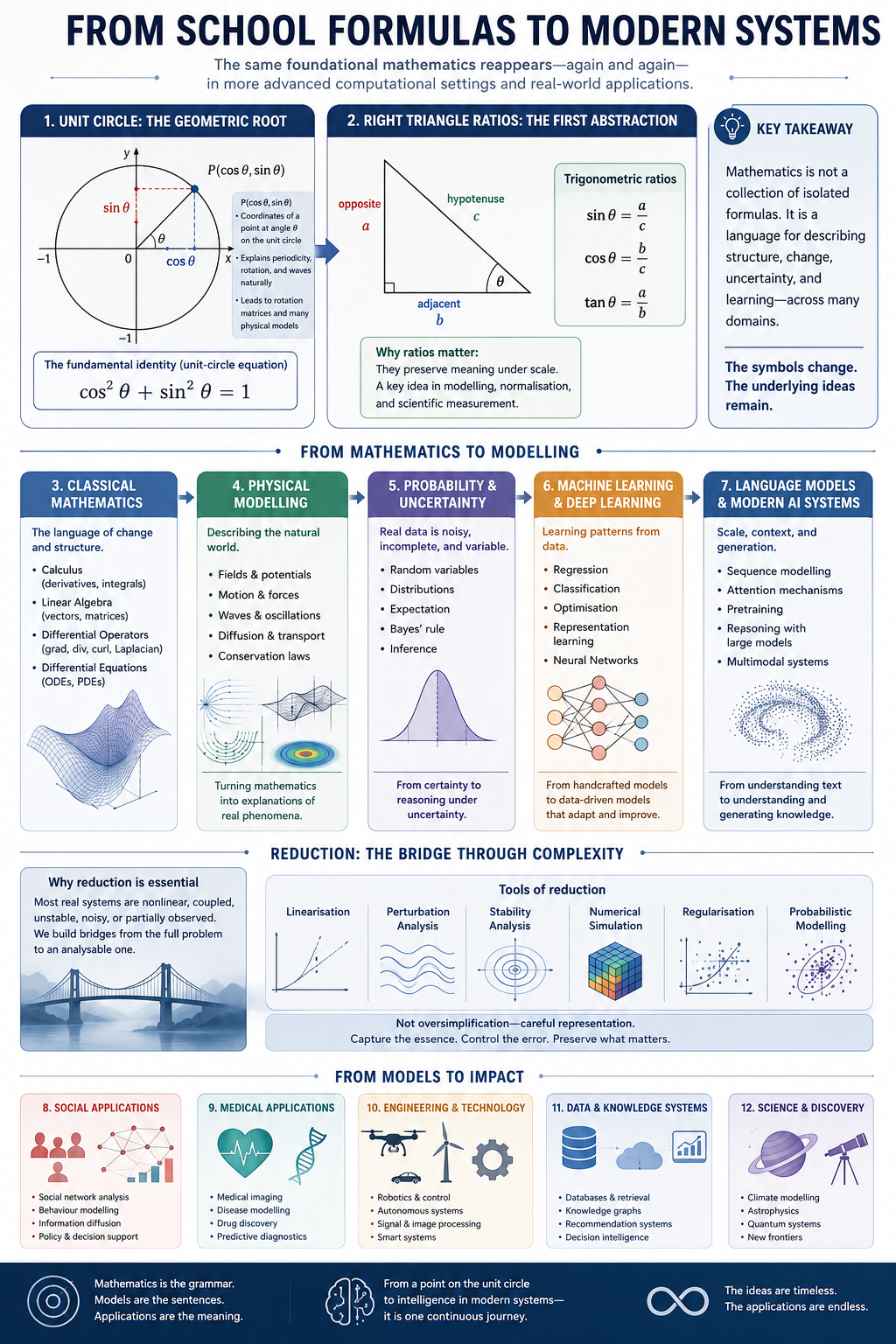
The figure below is meant to do more than look attractive. It is intended to summarise a chain of ideas that often appears fragmented when we first encounter it:
The point of the figure is not to claim that every modern system comes directly from one trigonometric identity. That would be shallow. The point is subtler: the same foundational mathematics keeps reappearing, often under different names, in more advanced computational settings.
For many students, trigonometry begins as memorisation:
\[\sin \theta, \qquad \cos \theta, \qquad \tan \theta.\]That is often where boredom begins as well. Without a geometric picture, these expressions can feel like arbitrary symbols.
But the unit circle changes the story.
The point at angle $\theta$ is
\[(\cos \theta, \sin \theta).\]That single statement already explains:
It also makes the classical identity
\[\sin^2 \theta + \cos^2 \theta = 1\]look much less mysterious, because it is simply the unit-circle equation in disguise.
This is one of the first places where mathematics becomes more meaningful when moved from memorisation into structure.
The familiar right-triangle definitions
\[\sin \theta = \frac{\text{opposite}}{\text{hypotenuse}}, \qquad \cos \theta = \frac{\text{adjacent}}{\text{hypotenuse}}, \qquad \tan \theta = \frac{\text{opposite}}{\text{adjacent}}\]are not just school exercises. They teach an important modelling habit: ratios can preserve meaning under scale.
That is already a scientific idea.
When a quantity is written as a ratio rather than a raw magnitude, it often becomes more stable, more transferable, and more interpretable. This is one reason trigonometric thinking survives into signal processing, coordinate systems, numerical geometry, and many imaging tasks.
In practical work, the same mental move happens again and again:
At a broader level, mathematical physics often begins by asking:
That leads naturally to ideas such as:
At school, these may appear as formal operations. Later, they become ways of describing very real phenomena:
The language becomes increasingly expressive. What once looked symbolic begins to function as a modelling grammar.
One of the hardest transitions in applied mathematics is realising that most important systems are not perfectly simple.
They are often nonlinear, unstable, coupled, noisy, or only partially observed.
This is where a deeper mathematical mindset becomes useful. Instead of asking for one perfect closed-form answer, we begin asking:
This is where reduction becomes central.
Reduction does not mean oversimplification. It means building a careful bridge from the full problem to an analysable one.
That same mindset appears in:
Many systems that appear chaotic or entropic at first sight become partially understandable only because we learn how to represent them in a better mathematical language.
Pure geometry and deterministic physics are powerful, but real data rarely arrive in clean exact form.
Measurements are noisy. Observations are incomplete. Biological systems vary. Sensors fail. Human behaviour is irregular. Real-world systems contain uncertainty by default.
That is why probability becomes unavoidable.
Probability gives us a disciplined language for:
This is not separate from the rest of mathematics. It is what allows structural mathematics to survive contact with imperfect reality.
In practice, many useful models stand at the intersection of:
That intersection is where a large part of modern quantitative science actually lives.
Machine learning often appears modern and self-contained, but it is built from older mathematical layers.
At a minimum, it depends on:
Even deep learning, which is nonlinear overall, is still assembled from repeated linear maps plus nonlinear activation functions and optimised through gradient-based updates.
That is why I no longer see older mathematics as “before AI” knowledge. It is still inside AI.
When people speak about deep learning, language models, or ChatGPT-style systems, the surface looks very different from school mathematics. The interface is fluent and conversational. The user does not see the mathematics directly.
But beneath that surface, the chain still holds:
Language models extend this into large-scale sequence modelling, contextual embeddings, attention mechanisms, and token prediction, but they are still mathematical systems before they are interface systems.
This matters because it prevents us from mystifying the technology. We can admire the scale and sophistication without forgetting that structure, approximation, and optimisation still govern the result.
For me, the most meaningful shift happened when I started seeing how these mathematical ideas move into domains that affect real lives.
In social systems, they can support:
In medical and biomedical settings, they can support:
That final step matters.
A formula becomes much more meaningful once it participates in a chain that runs from theory to an interpretable real-world outcome. In biomedical research especially, the path often looks something like this:
This is where mathematics stops being an isolated subject and becomes part of scientific responsibility.
When I was younger, I thought mathematics and physics were mostly about solving problems correctly.
Now I see them more as a layered framework for thought:
That sequence is not always linear, but it is one of the clearest ways I now understand how theory becomes practice.
The older formulas did not lose their relevance. I simply reached the stage where I could finally see what they were supporting.
I do not think every student must immediately love mathematics or physics. Confusion and boredom are real experiences. I had them too.
But I now think many of those early formulas deserve more respect than they often receive, because they are not merely decorative pieces of a syllabus. They are part of a long intellectual infrastructure that supports scientific explanation, computational reasoning, and practical systems.
Some of that infrastructure begins with a triangle.
Some of it begins with a circle.
Some of it appears in a gradient, a divergence, a curl, or a Laplacian.
Some of it appears in probability and inference.
Some of it appears in machine learning, deep learning, and language models.
And some of it returns, eventually, to human questions in medicine and society.
That is why I no longer see those old school formulas as time wasted.
I see them as the early pieces of a much larger map.