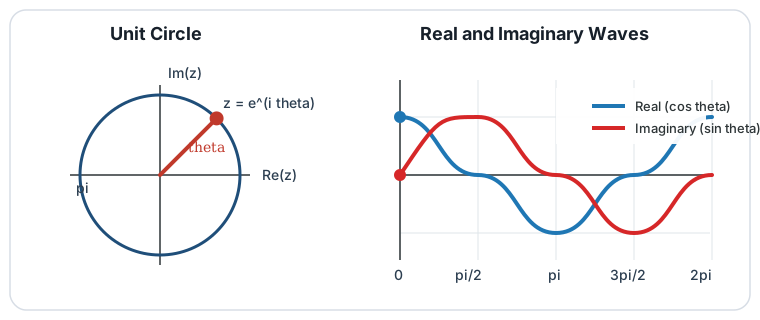
Few equations are as compact, famous, and conceptually rich as Euler’s identity:
\[e^{i\pi}+1=0\]Equivalently,
\[e^{i\pi}=-1\]In a single line, this equation brings together five of the most important constants in mathematics:
That is one reason the formula is so admired. It does not merely look elegant. It reveals an unexpected connection between ideas that first arise in very different parts of mathematics: arithmetic, geometry, algebra, and analysis.1
To understand Euler’s identity properly, it helps to distinguish Euler’s formula from Euler’s identity.
Euler’s formula is
\[e^{i\theta}=\cos\theta+i\sin\theta\]Euler’s identity is the special case obtained by setting $\theta=\pi$:
\[e^{i\pi}=\cos\pi+i\sin\pi=-1+0i=-1\]so
\[e^{i\pi}+1=0\]This means Euler’s identity is not an isolated miracle. It is a particularly beautiful consequence of a deeper and more general relationship between exponentials and trigonometric functions.1
One clean way to see why Euler’s formula is true is through the power series for the exponential, cosine, and sine functions:
\[e^x=\sum_{n=0}^{\infty}\frac{x^n}{n!}, \qquad \cos x=\sum_{k=0}^{\infty}\frac{(-1)^k x^{2k}}{(2k)!}, \qquad \sin x=\sum_{k=0}^{\infty}\frac{(-1)^k x^{2k+1}}{(2k+1)!}\]Now replace $x$ by $i\theta$ in the exponential series:
\[e^{i\theta} = \sum_{n=0}^{\infty}\frac{(i\theta)^n}{n!} = 1+i\theta+\frac{(i\theta)^2}{2!}+\frac{(i\theta)^3}{3!}+\cdots\]Using the fact that powers of $i$ cycle as
\[i^0=1,\quad i^1=i,\quad i^2=-1,\quad i^3=-i,\quad i^4=1,\]the even and odd terms separate naturally into real and imaginary parts:
\[e^{i\theta} = \left(1-\frac{\theta^2}{2!}+\frac{\theta^4}{4!}-\cdots\right) + i\left(\theta-\frac{\theta^3}{3!}+\frac{\theta^5}{5!}-\cdots\right)\]which is exactly
\[e^{i\theta}=\cos\theta+i\sin\theta\]Setting $\theta=\pi$ gives
\[e^{i\pi}=\cos\pi+i\sin\pi=-1\]and therefore
\[e^{i\pi}+1=0\]For many readers, this is the moment where the equation stops being mysterious and starts becoming profound.
Zero represents the neutral element of addition. For any number $a$,
\[a+0=a\]It is hard to imagine modern mathematics, algebra, or computation without zero. It is both a number and a structural idea: the reference point from which positive and negative quantities are measured.
One is the neutral element of multiplication. For any number $a$,
\[a\cdot 1=a\]Like zero, it seems simple, but it plays a foundational role. In algebraic structures, identities are what let operations hold together coherently.
$\pi$ is the ratio of a circle’s circumference to its diameter:
\[\pi=\frac{C}{D}\]It appears not only in geometry, but throughout calculus, differential equations, Fourier analysis, probability, and physics. It is irrational and transcendental, so its decimal expansion never terminates and never repeats.1
The constant $e$ arises naturally in continuous growth, compound interest, and differential equations. It is the base of the natural logarithm and the unique number for which the derivative of $e^x$ is itself:
\[\frac{d}{dx}e^x=e^x\]That property makes $e$ fundamental in continuous-time mathematics.1
The imaginary unit is defined by
\[i^2=-1\]This does not make it unreal. It extends the real number system into the complex plane, where numbers can encode both magnitude and direction. Complex numbers are essential in wave theory, circuit analysis, quantum mechanics, and signal processing.23
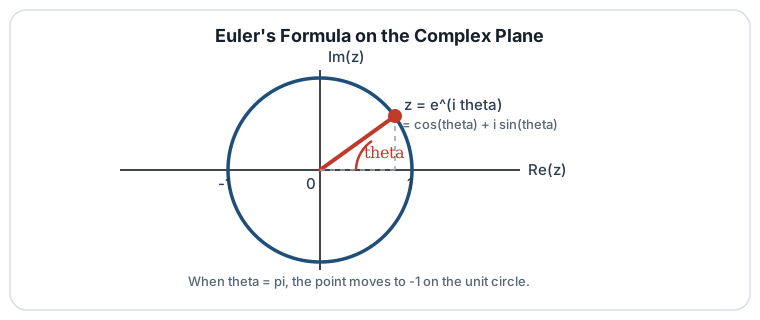
Euler’s formula becomes especially intuitive when viewed geometrically.
A complex number can be represented as a point on the complex plane, with the horizontal axis as the real part and the vertical axis as the imaginary part. According to
\[e^{i\theta}=\cos\theta+i\sin\theta,\]the number $e^{i\theta}$ lies on the unit circle at angle $\theta$.
So when $\theta=\pi$, the point lies exactly halfway around the circle from $1$, landing at $-1$:
\[e^{i\pi}=-1\]This is why Euler’s identity can be interpreted as a perfect half-turn. The exponential expression does not merely “grow”; in the complex setting, it rotates.
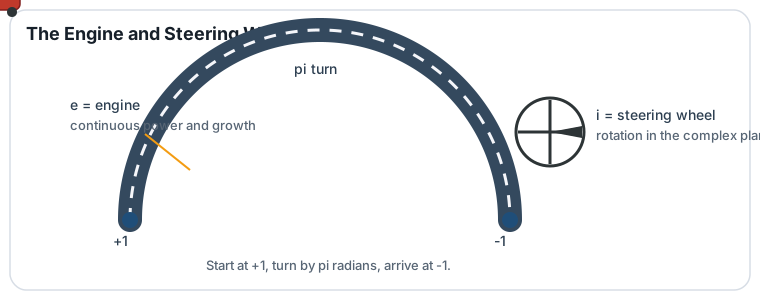
A good analogy is to think of the formula as combining motion and direction.
This analogy should not be taken as a proof, but it is helpful intuition. Euler’s identity says that exponential structure and circular motion are not separate ideas. They fit into one framework.
The importance of Euler’s formula extends far beyond pure mathematics.
In engineering and physics, oscillations are often written in the form
\[e^{i\omega t}\]where $\omega$ is angular frequency and $t$ is time. By Euler’s formula,
\[e^{i\omega t}=\cos(\omega t)+i\sin(\omega t)\]This compact form lets one represent sinusoidal motion, phase, and frequency in a single expression. That is why complex exponentials are standard in:
In practice, the real and imaginary parts encode cosine-like and sine-like components. Engineers often compute with the compact exponential form first and then extract the physically meaningful real part afterward.
The mathematics behind Euler’s formula also appears in probability and data analysis.
A core tool in signal analysis is the decomposition of a signal into frequency components. In discrete form, the key kernel is
\[e^{-2\pi i kn/N}\]This is the mathematical backbone of Fourier methods, which are used to detect periodic structure, filter signals, compress information, and analyze time-series data.2
In probability theory, the characteristic function of a random variable $X$ is
\[\varphi_X(t)=\mathbb{E}[e^{itX}]\]This is one of the most important bridges between probability and harmonic analysis. It encodes the distribution of a random variable in a form that is often easier to manipulate analytically.4
Whenever data are angular rather than linear, such as directions, phases, or times of day on a cycle, complex exponentials become natural tools. Circular statistics often uses the representation
\[e^{i\theta}\]because it respects the geometry of angles in a way that ordinary linear statistics does not.5
Complex numbers also appear when linear systems are analyzed through eigenvalues, eigenvectors, and spectral decompositions. Even when the data themselves are real-valued, the mathematics of oscillation and repeated transformation often leads naturally to complex-valued analysis.
This part needs careful wording.
Euler’s identity itself is not explicitly used in most machine-learning models. However, the broader mathematics behind it, especially complex exponentials, trigonometric structure, and Fourier analysis, appears in several computational settings.
Examples include:
A more accurate statement is this:
Euler’s identity is not “the formula behind all AI,” but the mathematics surrounding Euler’s formula plays an important role in several areas of modern computation.
That phrasing is both stronger and more scientifically honest.
Euler’s identity is often described as beautiful because it compresses a surprising amount of mathematics into one exact statement.
It connects:
Its beauty is not only that it is short. It is that it feels inevitable once understood, even though it looks impossible at first glance.
Euler’s identity is a reminder that mathematics is full of hidden unity. Ideas that begin in separate chapters of a textbook often turn out to be aspects of the same deeper structure.
What starts as a formula about exponentials becomes a statement about rotation.
What begins in pure mathematics becomes a working language for waves, signals, probability, and computation.
That is why
\[e^{i\pi}+1=0\]continues to fascinate students, scientists, and mathematicians alike. It is not just a clever equation. It is a compact window into how different parts of mathematics fit together.
NIST Digital Library of Mathematical Functions, Chapter 4: Elementary Functions. ↩ ↩2 ↩3 ↩4
Alan V. Oppenheim and Ronald W. Schafer, Discrete-Time Signal Processing. ↩ ↩2 ↩3 ↩4
David J. Griffiths and Darrell F. Schroeter, Introduction to Quantum Mechanics. ↩ ↩2
Eugene Lukacs, Characteristic Functions. ↩
Kanti V. Mardia and Peter E. Jupp, Directional Statistics. ↩
Ronald N. Bracewell, The Fourier Transform and Its Applications. ↩
Matthew Tancik et al., “Fourier Features Let Networks Learn High Frequency Functions in Low Dimensional Domains.” ↩