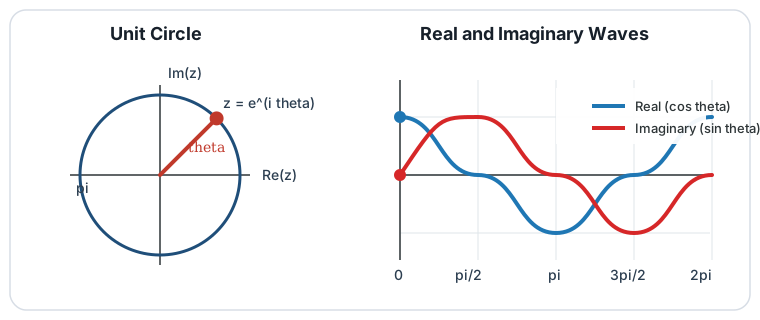
Euler’s identity is usually written as:
\[e^{i\pi} + 1 = 0\]or equivalently:
\[e^{i\pi} = -1\]This elegant equation unites five of the most important constants in all of mathematics:
0 as the additive identity1 as the multiplicative identitypi as the circle constante as the growth constanti as the imaginary unitLet’s visualize this relationship with a smaller moving diagram.
Euler’s identity elegantly connects five fundamental constants, each with its own profound significance.
Zero represents nothingness, the empty baseline from which counting begins. It is the additive identity, because adding zero leaves a number unchanged. Without zero, the modern number system would be incomplete.
One is the foundation of counting and the multiplicative identity. Any number multiplied by one remains itself. It is the simplest positive integer and the basis from which the natural numbers are built.
$\pi \approx 3.14159\ldots$ emerges naturally from the geometry of circles and spheres. It is the ratio of a circle’s circumference to its diameter, appearing throughout physics, engineering, and natural phenomena. It is transcendental and irrational, so its decimal representation never repeats.
$e \approx 2.71828\ldots$ is the base of natural logarithms. It emerges from compound interest, exponential growth, and appears in physics, biology, and chemistry. When something grows at a rate proportional to its current size, $e$ appears naturally.
The imaginary unit satisfies:
\[i^2 = -1\]While it seems abstract, complex numbers are essential for describing waves, quantum mechanics, electrical engineering, and signal processing. The label “imaginary” is historical. They are just as real as any other mathematical construct.
What makes Euler’s identity so remarkable is how five independent concepts, arising from completely different domains of mathematics, combine into one perfect equation:
\[e^{i\pi} = -1\]This single equation encapsulates:
eipi, which equals exactly half a circle-1e^(i pi) + 1 = 0The beauty is not just mathematical elegance. It is a revelation that these seemingly disparate concepts are deeply interconnected. They are not separate truths. They are facets of a single underlying reality.
Think of Euler’s identity like a car journey:
e is the engine. It provides the continuous power and growth.i is the steering wheel. It controls the direction, allowing rotation in the complex plane.pi is the perfect turn, exactly half a circle or 180 degrees.-1 means you arrive exactly opposite your starting pointThe equation e^(i pi) + 1 = 0 is like saying: if you drive with the engine running while turning the steering wheel exactly halfway around, then add your starting position to your ending position, you get perfect balance, zero.
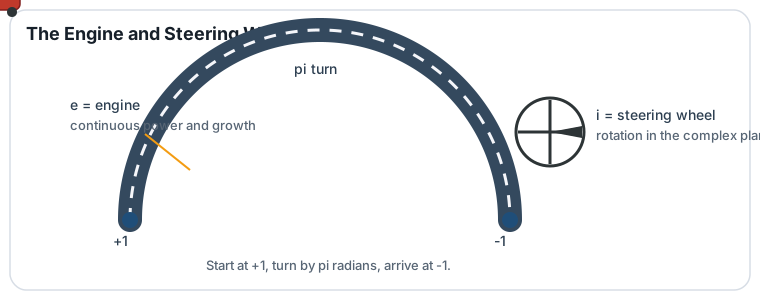
Imagine standing at point +1 on the real number line and applying the transformation e^(i pi):
i pi instructs the exponential to perform a complex rotation of pi radians in the complex plane+1, a pi radian rotation brings you exactly to -11So the transformation gives e^(i pi) = -1, and therefore:
In physics, this describes how oscillating systems behave. Waves naturally follow the pattern e^(i omega t), combining an exponential envelope, oscillation frequency, and phase relationships. This is how alternating current circuits operate, how radio waves propagate, and how quantum wavefunctions evolve through time.
Euler’s identity is fundamental to describing periodic and oscillating phenomena:
e^(i theta) to describe probability waves and superpositione^(i omega t)e^(i theta) to design stable feedback loopse^(i omega t) componentsThese ideas are not decorative. They are the working language of waves, fields, and oscillatory systems.
Though less obvious, Euler’s identity also underlies modern data analysis.
Euler’s identity is surprisingly central to modern AI and computing:
z = e^(i theta) style parameterizationsThese ideas show up in practical systems:
What makes Euler’s identity special is that it connects:
All of that appears through one elegantly compact equation.
This suggests that Euler’s identity is not just a mathematical curiosity. It is a compact description of how reality encodes and transmits information across scales, from quantum mechanics to classical physics to artificial intelligence systems.
In many ways, understanding Euler’s identity is understanding part of the language that nature uses to communicate with itself. Its beauty lies not just in mathematical correctness, but in revealing that seemingly separate mathematical concepts are fundamentally connected.